顯示包含「learning difficulties」標籤的文章。顯示所有文章

2017年5月2日星期二

World Voice Hong Kong Teachers’ Forum -- Creative approaches in addressing diverse learning needs in Hong Kong

World Voice Hong Kong Teachers’ Forum -- Creative approaches in addressing diverse learning needs in Hong Kong

The British Council will host the World Voice Hong Kong Teachers’ Forum - Creative approaches in addressing diverse learning needs in Hong Kong


This is the first Forum we will bring together Hong Kong academics, expertise, teachers and parents to discuss a number of challenges or issues surrounding students with diverse learning needs students. This will be a view to progressing policy thinking and schools practice in the following areas:
  • Defining the types of diverse learning needs?
  • Current policy, support and opportunities for students with diverse learning needs. 
  • What is the current situation that teachers face every day?
  • How to address the challenges/ issues? What are the creative approaches? 
  • Forecasts and future opportunities
AIMS AND OBJECTIVES
___________________________________________
The Forum will provide a platform for participants to:
Examine the key challenges/ issues facing teachers, parents and students
Share and discuss the latest policy direction
Sharing good practices and innovative ways to address students with diverse learning needs?

PROGRAMME RUNDOWN
___________________________________________
Date: Wednesday, 24 May 2017
Time: 10:00 – 16:00 (09:45 Registration)
Venue: British Council Hong Kong Office, 3/F, Room 307


CONTACT


For queries about the World Voice Hong Kong Teachers’ Forum, please contact Shirley Wan at WorldVoiceHK@britishcouncil.org.hk 


2013年5月7日星期二

Three in five parents with learning difficulties will have their children taken into care, charity estimates

More children are being placed in care
CHILDCARE experts say these parents would be better able to cope if they received more support.

AROUND three in five Scots parents with learning difficulties will have had their children taken into care, compared to just two in five parents in similar circumstances south of the Border.

Children's charities and officials are now demanding more research into the care system in Scotland.

An official from the Scottish Consortium for Learning Disability warned Holyrood's Education and Culture committee that the figure in Scotland could be even higher.

And Scotland's Commissioner for Children and Young People Tam Baillie has also highlighted disparities in the general number of children taken into care across Scotland's 32 local authorities, with some councils removing more children than others with similar socio-economic profiles.

SCLD business and partnerships manager Andy Miller said: "Some estimates are even higher, at six out of 10 children (taken from) parents with learning disabilities.

"Our own view is that is too high. I don't know what the figures are for other vulnerable children who have parents with addiction or mental health problems. It might be equally high. It certainly feels high.

"Parents with learning difficulties find it really difficult to get the right support they need to parent, or even any support at all. We hold the view that with better support for parents, that number would drop significantly."

Mr Baillie told the committee there is a lack of consistency between care professionals and local authorities about the appropriate level of intervention.

He said: "Some of that can be accounted for by levels and concentrations of poverty, but not all of it.

"You will have councils with similar profiles, in terms of their socio-economic circumstances, who have got quite different rates of children being taken into a care or are being looked after.

"That begs the question of what else is going on there?"

"Resources play a large part in decision-making, but this is only part of the problem. Concerns about poor outcomes for children are reflected in various reports produced over the last decade and being aware of these poor outcomes will no doubt influence the decisions of professionals to move or not move children into care.

"Moreover, the availability of suitable placements and numbers of placement moves that some children are subjected to also impacts on decisions to remove children, in some cases when a move is needed.

"Decisions to remove should be led by the child's best interests and not by resources."

2013年1月4日星期五

Child learning difficulties: choosing the right school

Every opportunity: lessons at Bethany School. 
A supportive school with the right ethos and technical provision will help your child to flourish, says Virginia Matthews.

“Dyslexia may be an obstacle, but as long as you choose the right school there is no reason why a dyslexic child shouldn’t achieve everything their heart desires.”

So says Francie Healy, head of the co-educational Bethany School in Goudhurst, Kent, one of a growing number of mainstream independent schools to offer specialist teaching for dyslexia, dyspraxia and Asperger’s Syndrome.

Bethany’s specialist dyslexia unit caters for groups of around six and is strategically sited in the middle of the main teaching block. “Our approach is to keep all the children together most of the time and to withdraw those needing extra support for tailored sessions when necessary,” says Healy.

“I would advise all parents of dyslexic children to look at where they’ll be for most of the day and to decide whether the school’s approach fosters inclusion or separation.”

With some 10 per cent of the population thought to suffer from dyslexia — symptoms range from mild spelling difficulties to a chronic inability to read and write or severe absent-mindedness — it’s little wonder that independent schools are keen to establish their credentials in this area.

But Brendan Wignall, headmaster of Ellesmere College in Shropshire, and chairman of the Council for the Registration of Schools Teaching Dyslexic Pupils (CReSTeD), says that the relatively small number — fewer than 80 — of schools recognised by this charity suggests provision is patchy.

“You’d expect me to recommend that parents look first and foremost for the CReSTeD seal of approval but, sadly, some schools with dyslexia units see them as little more than a marketing opportunity and, in extreme cases, discourage dyslexic pupils from staying on in case it affects [overall] results.”

He adds that it is vital to question whether the school is in the right place spiritually and culturally. “A mismatch between the confidence-boosting a dyslexic child receives in a specialist unit and the thoughtless barracking they may encounter at the hands of the head of maths an hour later could be very damaging.”

Structured teaching and small class sizes, standard in many independent schools, can be vital for children with dyslexia. But for Carolyn Billson, whose son James attended Bethany before going to the University of Reading, the ethos of the school was all-important.

“Having discovered James has moderate dyslexia with dyspraxic tendencies, we did the rounds of the local private schools. Bethany seemed such an excellent school that we would have chosen it even if it hadn’t had a specialist unit. The practical coping strategies and the support James received transformed his approach to study,” says Billson.

At the boys-only More House School in Frensham, Surrey, which specialises in language-processing problems, headmaster Barry Huggett endorses an individual approach. “Athough we don’t see ourselves as an academic powerhouse, we have the facilities to offer all 413 pupils what amounts to a customised timetable reflecting how each one learns and processes information. So all boys are given the opportunity to take eight or nine GCSEs.”

Former More House parent Sue Olen says that for her son, Oliver, now in his final year at the University of Derby, problems with dyslexia began early. “He had severe difficulty reading [at pre-school stage], and at junior school he was in tears daily due to his frustration at being unable to keep up.”

The family paid the first year’s fees at More House, but once Oliver had been granted a Statement of Special Educational Need — a document issued to pupils with significant difficulties that details the help they should receive — the local authority picked up the tab for the remaining six. “The confidence-building that came from being taught alongside other boys with similar problems changed our son’s life,” says Olen.

Established in 1946 and with only 96 pupils aged between seven and 17, Frewen College in Rye, East Sussex — where term fees from Year 7 start at £6,593 for day pupils and £9,252 for boarders — was the UK’s first specialist dyslexia school. With each house named after a celebrated dyslexic — Sir Richard Branson, Nigel Kennedy, Sir Steve Redgrave and Jamie Oliver — the college sees positive role modelling as crucial.

“Once you’ve found a school with technical provision for dyslexia, find out how many one-to-one or small-group sessions are included in the fees and examine the school’s track record,” says the college’s business manager Jeremy Field. “Look beyond the glossy brochure.”

By Virginia Matthews
6:30AM GMT 01 Jan 2013

2012年6月24日星期日

學習數學障礙

【聯合晚報╱記者林進修╱台北報導】

飽受數學學習障礙之苦的孩子有救了。中央大學認知神經科學研究所副教授吳嫻利用現代認知神經科學技術,探討人類對數字、時間及空間訊息處理的心理表徵及運作方式,找到數線習慣模式,可增強孩子對數字的空間感,讓他們不再視數學為畏途。

吳嫻表示,人類腦中對計算數字這件事,有相當精密的時間及空間生理機制,1到9這幾個阿拉伯數字,明明出現在眼前的時間一樣,卻有不同的空間感受,進而出現不一樣的反應。

她舉例,當在一顆草莓上貼上1或2的數字,人們的本能會覺得它是個「小」數字,伸手去拿這顆草莓時,手指張開的弧度較小;反觀若在這顆草莓貼上8或9,就會覺得是個「大」數字,伸手拿草莓時的手指張開弧度,就會不自覺地變大。

吳嫻說,一些對數學有學習障礙的孩子,通常對數字的空間感不足,當然會影響學習意願及成果。她建議家長不妨透過心理數線的訓練,增加大腦處理數量的表現。

最簡單的方法,就是在紙上畫一條直線,從左到右標示1到100等數字,然後說出一個數字,再讓孩子去標示這個數字的相對位置,比如37距1較近、距100較遠,而73則相反,距1較遠、距100較近。經過不斷地訓練,可增強孩子對數字的空間感,讓他們未來面對數學這門功課時,會有較好的表現。

吳嫻是中央研究院今年的年輕學者研究著作獎15位得獎者之一,她上午發表論文時強調,大腦對數字、時間及空間都有表達精準向度的能力,比如進入一個會場後,會立即知道會場有多大、裡面有多少人及所處位置。對一些能力較差的人,只要經過訓練,還是可以收到不錯的學習效果。

2012年5月25日星期五

讀寫障礙「學.藝」夏令營2012

香港教育學院特殊學習需要與融合教育中心與東華三院教育心理服務中心將於 2012年7月16-20日舉辦「學.藝」夏令營2012 活動。透過多元化的藝術活動,以及由香港教育學院一眾準教師組成的團隊設計的學習活動,增強讀寫障礙學生的自信及學習動機,讓他們渡過有趣、寓學習於遊藝的一星期!

活動名稱:「學.藝」夏令營 2012

日期︰ 2012年7月16日至20日
對象︰ 小三至小五讀寫障礙學生 (11-12年度)簡介會
地點︰東華三院黃鳳翎中學新界沙田馬鞍山馬鞍山路208號(馬鞍山警署旁)
課程地點︰香港教育學院(大埔露屏路10號)

備註:更多活動詳情請參閱附件。 是此活動名額有限,先到先得。如有任何查詢,請致電東華三院教育心理服務中心 2859-7483 與霍姑娘聯絡。


2012年5月21日星期一

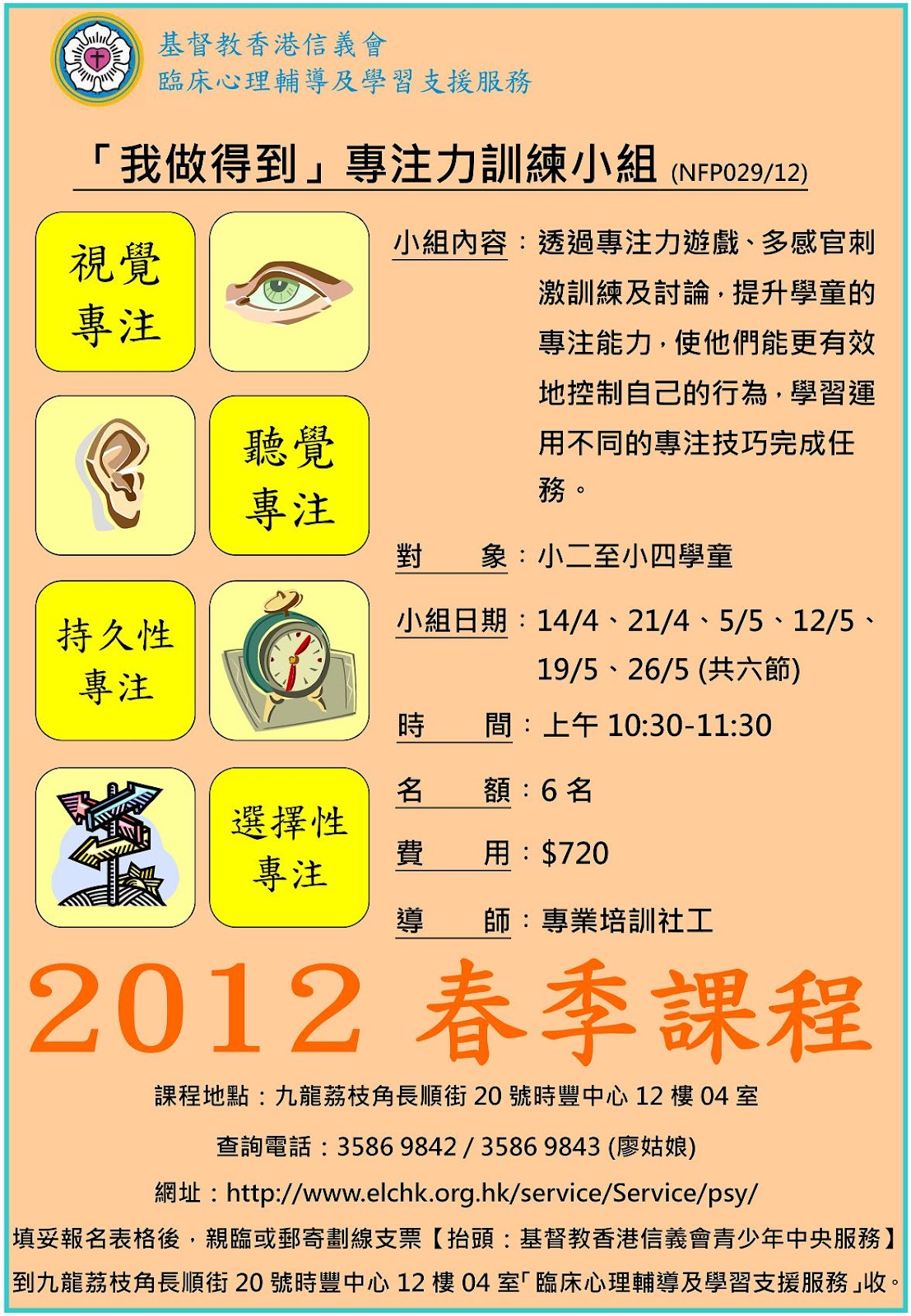
7- 8月份 下列地區舉辦讀寫技巧與專注力訓練的小組

信義會臨床心理輔導及學習支援服務將於 7- 8月份
下列地區舉辦讀寫技巧與專注力訓練的小組

荔 枝 角 區


天 水 圍 區


將 軍 澳 尚 德 區


如有任何疑問,歡迎致電查詢廖姑娘 3586 9843,謝謝﹗


2012年5月19日星期六

小童群益會助障童讀寫

嘉賓出席「童心悅學—才藝展現」成長計劃啟動禮 
香港文匯報訊 由香港小童群益會主辦,美國安利(香港)日用品有限公司贊助,並獲政府攜手扶弱基金支持推展的安利「童心悅學—才藝展現」成長計劃,日前假香港理工大學蔣震劇院舉行啟動禮。著名DJ貴花田及「年輕發明家」梁頌軒同學即席分享他們如何成功克服讀寫障礙,並鼓勵社會各界關注讀寫障礙兒童及其家庭。
 大會邀請到教育局常任秘書長謝凌潔貞、立法會社會福利界議員張國柱、社會福利署攜手扶弱基金秘書處計劃經理黃國強、美國安利(香港)日用品有限公司總經理陳呂淑及香港小童群益會總幹事羅淑君擔任主禮嘉賓,與一眾參與計劃的小朋友進行啟動儀式。
 陳呂淑表示,深信安利「童心悅學—才藝展現」成長計劃可以讓讀寫障礙兒童及其家庭,得到社會的正面支持及鼓勵,為兒童締造健康和愉快的童年。
 超過200名參與計劃的兒童、家長及「悅學大使」隨後進行多元才藝啟導活動,合力設計獨一無二的名牌,象徵三方於未來一年將一同經歷、學習及努力克服讀寫障礙。

2012年5月16日星期三

患讀寫障礙 忌將勤補拙(7-10歲)


【明報專訊】女兒在主流學校讀小一,曾做過私人評估,說她在讀寫上有少許障礙,學校已有所安排。但她做功課依然很慢,現在一看見課本就說眼睏或頭痛、看不清等……對家人發脾氣,又推說心情差。我懷疑她是借自己有讀障而借題發揮,請問該如何處理這類孩子?
雖然孩子被評估為讀寫障礙,但智能正常,故能像普通人一樣學習,只是在處理文字方面的認知能力弱較,用文字學習時有困難。同樣,有讀障的孩子也和其他孩子一樣,要平衡學習與玩樂的安排,不要一心以「將勤補拙」來填補讀寫障礙,反而要調整合理期望,讓孩子能按個人步伐學習。

按孩子能力調節

因此,家長先要令孩子在讀寫問題上及時得到適當的支援,如抄寫、默書的調息等,以助他們掌握文字的方法,有效地學習。不同的學科、應付方法也要按孩子的能力調節,分清楚是書寫還是理解上出現困難,例如數學題目理解、串英文生字和寫中文字,要視乎孩子的特質,參考不同教材,用圖像化、人物化等,刺激孩子的感官以加強吸收。孩子對感官刺激反應敏銳,所以也要注意學習環境,要配合學習材料,免受周遭事物分散注意力,才能專心吸收課文內容。
由於這些孩子的學習能力較其他同學弱,自我形象及社交發展方面亦受影響,很容易感到挫敗而缺乏自信心。所以,家長除留意孩子的情緒變化外,不妨多參加合適的跟進輔導組。多欣賞孩子付出的努力,在學習安排上輕鬆點,情緒化的行為問題也會相應減少。例如她已累了,要安排小息,待回復過來再努力,比硬是撐着學習下去有效率得多。
資料提供﹕協康會教育心理學家翁偉傑

2012年4月2日星期一

調查顯示英國五分之一成年人有讀寫障礙


中新網3月29日電 據外媒報道,調查顯示,英國五分之一的成年人是“功能性文盲”。這意味著,全英國有800萬人在日常生活中有讀寫障礙。


報道稱,英國教育體系的不足導致了這種情況的出現,使許多成年人甚至連看懂說明書都感到吃力。如今,因人才缺失造成的收入減少以及更多社會福利的支出,已使英國政府每年花費810億英鎊。這個龐大開支是德國的2倍,法國的3倍。


據此,英國教育部發言人表示,“我們已經決定推動國民文化程度的提升。”


另據國際經濟合作和發展組織(OECD)的一項調查,英國的中小學生在讀書上從世界前七名下落到第25名。此外,還有一項調查顯示,兒童早期的學習質量對他們上中學仍有影響。英國教育部的一名發言人說,英國正在下功夫努力改善兒童的識字率


來源:中國新聞網 

2012年3月10日星期六

助展會:學障兒童 · 學會學習 工作坊

學障兒童 · 學會學習 工作坊

有學習困難的兒童, 學習常遭挫敗, 以致缺乏動機和信心, 成績也未如理想。 因此, 我們特意從「腦功能訓練」和 「學習策略指導」兩方面著手, 從根本幫助他們突破障礙, 並針對性地改善他們的學習能力, 讓他們最終學會學習, 重拾學習的興趣, 學業成績也得以提高。

本工作坊特別為 學障兒童之家長、老師 及輔導者而設。內容分兩部分:

1. 「腦功能訓練」:
講解學障兒童的腦功能障礙及 訓練方法,包括:身體感官、語言和思維及左右腦功能 方面發展

2. 「學習策略指導」:
以中英文科為例: 講解及示範適用於學障兒童的學習技巧

講者:
助展會兒童發展治療顧問 陳玉珍姑娘
語言治療及教育顧問 夏小月姑娘
視覺訓練導師 許卓琦姑娘
學習策略導師 李秀芳姑娘
日期:4月11及18日(星期一)時間:晚上7時至9時30分
地點:助展會 名額:20 費用:HK$350
報名及查詢: 請電 2528-4096 或  詳情及報名表按此

2012年2月24日星期五

讀寫障礙治療方法 學輸入法助認字


患讀寫障礙的兒童,因「記唔到字」的問題,引致認字及誦讀出現困難。本港有研究估計約一成兒童患有讀寫障礙,嚴重影響學習,患者若不及時接受治療,長大後不但影響日常生活,甚至撰寫履歷,以致求職面試也有困難。

協康會教育心理學家黃俊傑表示,患有讀寫障礙的兒童,智力與常人無異,但因認字及讀字有問題,致掌握的詞彙不多,「一般小朋友兩至三次就認到字,但讀障兒童睇好多次都唔記得,連默書都默唔到」。他表示每月都會為三至五名兒童進行相關的評估與治療。他表示患者通常升讀小一或小二時,會被老師發現有讀寫障礙。較年幼的患者,可透過學習特別的記字技巧,如拆字、按部首或故事化等改善認字能力;高中或大學生能透過多採用電腦輸入文字,如學習不同的中文輸入法,以幫助記憶拆字及用字,改善讀寫障礙的問題。英文拼音相對較易掌握,讀障兒童讀中文時,遇到的障礙會較大。

2012年2月23日星期四

中大揭秘可助治療讀寫障礙兒童 讀中文字有獨特腦電波

香港文匯報訊(記者 劉景熙)漢字與英文、法文、西班牙文等拉丁語系文字,素來被認為屬於「兩個世界」,因為雙方字義結構、發音不盡相同,運作南轅北轍。中文大學心理學系助理教授張學新破天荒首次發現,人類閱讀具意義漢字詞彙時,腦部會發出「N200」電波,為所有文字閱讀中獨有。「N200」電波在看圖畫以及無意義字詞組合時不會出現,張學新成功以具體科學實驗結果,力證漢字並非單純「象形」文字,兼備人類文明獨一無二的「拼義」性質。張學新指,「N200」為腦認知科學研究突破,也為了解大腦運作、診治閱讀障礙等問題帶來新啟示。

進行實驗時,實驗者要戴上「特製電波感應頭罩」,偵測腦電波變化。
香港文匯報記者劉景熙 攝

與內地合作 3年獲成果
是次研究,同時獲得北京大學、中國科學院心理研究所、汕頭大學等參與協助,歷時3年,共花約67萬元經費。研究除了包括文字體系理論及分析基礎外,亦涉及大量認知心理學實驗。懂得漢字的參與者須戴上「特製電波感應頭罩」,坐在電腦前。過程中,漢字詞彙會不斷在熒幕閃過,但會混雜象形圖畫、無意義字詞組合(如「技究」),以及其他各種文字,包括與漢字相仿的朝鮮文字、拉丁語系的英文等。當實驗者看到漢字詞彙時,需要按鈕示意明白。

實驗數據顯示,參與者看到「有意義漢詞」後約0.2秒,有一組處於腦部頂中央的腦電波,以倍數計急速增強,但有關情況不會在其他文字,以及無意義字詞組合閃過時出現。經過500多人與共36次實驗驗證後,張學新確認有關電波在「漢詞理解」的獨特地位,並把該電波命名為「N200」。

超越「象形」 成為「拼義」
張學新分析,「N200」除了顯示漢字獨特性外,更是一項強大科學證據,證明漢字具有超越「象形」的特質,「看到圖畫及無意義字組時,『N200』根本沒有出現,反映理解漢字已超越『象形』概念,閱讀者能看到圖像以外的信息」。他認為,有關情況正是不少文字理論中提及的漢字「拼義」層面。

此外,張學新表示,研究對了解文字與人腦之間的關係帶來突破,如科學家能進一步找到人類閱讀漢字時,運用腦部哪一個部分,更可望提升治療閱讀障礙等腦部疾病機會。「N200」的發現,獲學術界高度重視,相關實驗論文早前獲內地自然科學刊物《科學通報》刊登為2月號封面故事。

盼集中精力 覓電波來源
張學新又坦言,原本專注於研究人類記憶系統,是次在語言文字領域獲得突破性成果,實在超出預期,「因記憶離不開語言,我需要了解更多語言研究。不過,幾年前,我嘗試尋找關於漢語研究的文獻時,卻發現數量很少,有感學術界對中文詞彙不夠重視。於是,我轉攻漢語方面的認知心理學」。他表示,希望下一步集中精力,準確找出「N200」來源,繼續探索人腦奧妙。

2011年8月29日星期一

話題聚焦:兒童讀寫障礙,我那聰明的“笨”女兒 ( 3 )

讀寫障礙是一種最常見的學習障礙。有讀寫障礙的孩子,不能正確處理口頭或書面的語言文字信息。他們在拼字、書寫、閱讀、聆聽或者是做算術時,會覺得非常困難。與自閉、多動等其他障礙相比,讀寫障礙兒童的基數更大、表現卻更不明顯,特別值得關注。讀寫障礙家長們面對著艱難的困境:“我們會繼續陪著我們的孩子,直到他們能以自己的形式展現自我。然而,我們能堅持多久,孩子又能堅持多久?”


   進步與挫折

三年級上學期的期中考試,欣欣是在一個單獨的屬於她的“辦公室”裡考試的。一位老師專門為她朗讀題目。讀寫障礙兒童的表現各不相同,欣欣的聽覺並沒有問題。


這次考試成績比欣欣平時成績平均提高了20分左右。


事實上,欣欣​​並不樂意接受這樣的照顧:“媽媽,為什麼我要和別人不一樣?”


在此之前,余靜佳已向學校請求,允許欣欣缺席下午兩堂課,由家教幫助她完成作業。隨著課業一年年變難,欣欣做作業的時間越來越長,余靜佳不得已請求這樣的特殊安排。學校表示支持,特意為欣欣安排了一間空房間。


欣欣還是不樂意:“媽媽,你是想讓全校人都知道我有問題嗎?”


“抱歉,媽媽還沒有考慮到這一點”,余靜佳想了想說,“要不你先試一個星期?如果你不喜歡,媽媽也不堅持了。我們再想別的辦法。”


過了幾天,欣欣開心地主動向媽媽誇耀起她的“辦公室”來。裡面有一張搖床,還有一張大沙發,就連靠枕也是卡通圖案的。她帶同學們參觀,“別人都羨慕得要死”。


余靜佳除了請家教,她還帶著欣欣參加了教育機構矯治。孩子每季度還需要直飛深圳一次接受培訓。只要有時間,臨睡前她也陪著欣欣一起閱讀。


然而,兩年多過去了,欣欣的讀寫障礙矯治效果卻不怎麼明顯。即便得到特殊安排,從下午就開始寫,她的作業還是要到晚上八九點鐘才可以完成。


讀寫障礙不是疾病,沒有藥方也不可能治愈,只能通過長時間的訓練得到緩解和克服。對欣欣來說,一切都還只是剛剛開始。


“她只是在逐漸認知,自己不是容易考100分的孩子。不管多努力,她就是經常只能考60分的孩子。”


  欣欣還不知道什麼是讀寫障礙。她有次問媽媽:“為什麼你要求姐姐考100分,卻從不要求我呢?”


余靜佳回答說:“別說你考60分,只要你付出了努力,你考零分都是很棒的。每個人的強項不一樣,你是特別的孩子。”


欣欣卻不依不饒:“媽媽,我就要考100分!”


終於有一次,欣欣的數學突然考了99分。她回家大哭一場:“媽媽,我就差一分就是100分了!”  

余靜佳一陣心疼。她總是為好勝而堅持的孩子心疼——當女兒好幾天都記不住一個簡單英文單詞的時候,當女兒問她自己為什麼不能當學習委員的時候,當女兒拿回試卷不願說分數的時候,特別是,當女兒堅持以100分為目標的時候。

“我不知道二年級是苦的,一年級是甜的……我愛的是甜,苦我不喜歡。”這是欣欣的一篇日記。這個不到10歲的孩子,將標題取為《我的苦》。


“學校和老師都已經很配合我了,但是整個教育體係並不適合這樣的特殊孩子”,余靜佳終於決定,在四年級將兩個女兒都轉入國際學校就讀。


在那裡,或許欣欣的繪畫天斌可以被更加充分地發揮。上課時做筆記,別的孩子用單詞,她用圖畫。襯衣、褲子,用符號記錄意義,“用特別準確、簡單的圖示,不像別的孩子一畫就複雜了。”


欣欣起初想做獸醫,最近想做服裝設計師,偶爾還會說繼承媽媽的事業做一名建築師。她的體操練得很好,單手倒立是班上活動時的保留節目。


她也仍然很努力。余靜佳正在籌劃,建立一個民間公益機構,幫助更多類似問題的中國孩子。與自閉、多動等其他障礙相比,讀寫障礙兒童的基數更大、表現卻更不明顯,特別值得關注。


有一次,欣欣問媽媽:“為什麼別人播種都馬上開花了?為什麼我播那麼多種子,都沒有開花啊?”


余靜佳忍住眼淚,微笑著回答:“種一粒種子,就會收一粒果實。有的人很多時候都沒有收,但是突然有一天,哇,她收了很多很多的果實。欣欣,你的那一天還沒有到來呢。”